

The Most Detailed Short-Term Rental Tax Loophole Guide
By Ana Karina Klein, CPA, Owner of The Tax Boss
Quick answer: The short term rental tax loophole is a legal tax strategy, written right into the tax code, that lets high earners use paper losses from a short-term rental to offset their W2 or business income. Done right, it can wipe out tens of thousands, even hundreds of thousands, of dollars in taxes. But there are two requirements, and both are nonnegotiable:
- Keep your average guest stay at seven days or less
- Materially participate in the rental
Here’s exactly how it works.
If you’re a high-income earner making over $150,000, single or married, and you’re tired of writing checks to the IRS, this strategy could work for you.
If all you have is W2 income, there are very few legal ways to meaningfully cut your tax bill. But one strategy still works. It’s legal, written directly into the tax code, and when done right, it can wipe out hundreds of thousands of dollars in taxes. It’s called the short-term rental tax loophole.
In this guide, you’ll learn:
- How real estate lets you legally reduce your taxes
- The difference between long-term and short-term rentals
- What the short-term rental tax loophole actually is
- How to qualify, and how to stay audit-ready
- A real client example with real numbers
- The downside you need to understand before you invest
Why real estate lets you legally lower your taxes
To understand why the short-term rental tax loophole works, you first need to understand the difference between active and passive income.
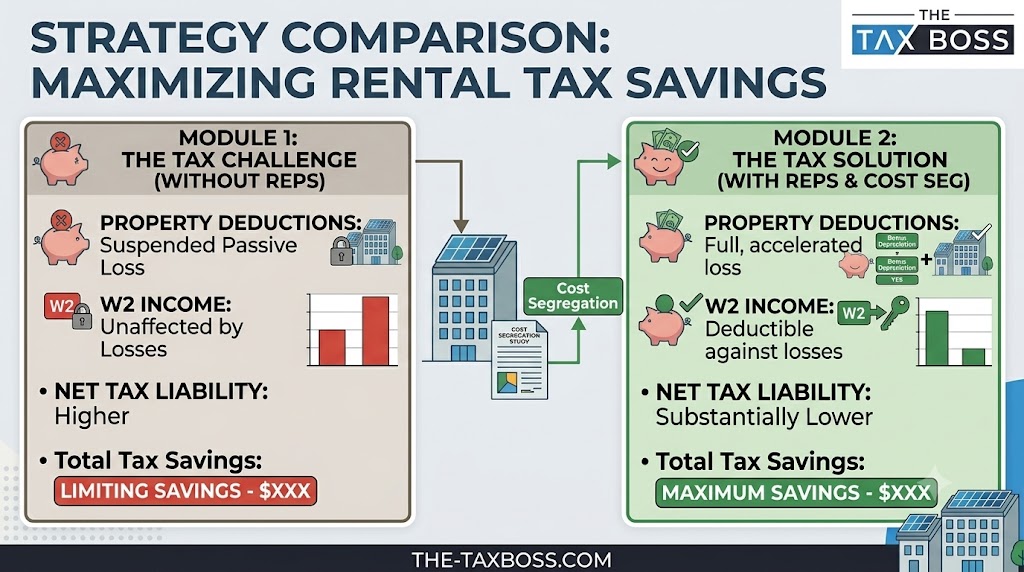
Active income is your W2 or business income, and it’s taxed at the highest rates, up to 37%. Real estate income, by law, is treated as passive [IRC 469(c)(2); Treas. Reg. 1.469-1T]. And passive losses, including losses from rentals, generally can’t offset active income.
There are two ways around this:
- You, as the taxpayer, qualify for Real Estate Professional Status (REPS). See the Real Estate Professional Status requirements to learn more. This is extremely hard to do with a full-time W-2 job. I’d (and the courts) even argue it’s almost impossible. Or…
- You use the short-term rental loophole.
How depreciation creates paper losses
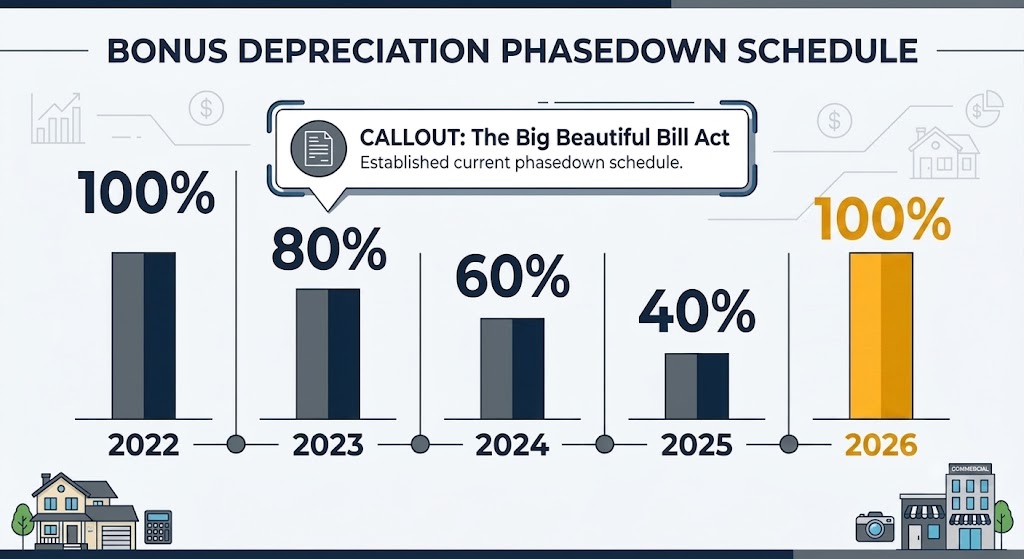
Once you qualify for either path, the next piece is depreciation. In addition to owning the real estate, taxpayers use depreciation and, in 2026, bonus depreciation, paired with a cost segregation study (more on that later), to offset their active income. This depreciation creates what we call a paper loss. You don’t actually lose any cash, but the tax code lets you deduct it anyway. That’s the magic.
Why long-term rentals don’t touch your W2
Rentals with stays longer than 7 days are classified as passive. Think month-to-month leases, mid-term leases, annual leases, and corporate leases.
So, say you’re a married couple making $500,000 as doctors. You buy a long-term rental and use depreciation to create paper losses. Those losses still can’t offset your W2 income, because the rental itself is passive.
That’s where short-term rentals change the game.
How short-term rentals change the rules
There’s an exception in the tax law: Treas. Reg. 1.469-1T(e)(3)(ii)(A) says an activity can be treated as active if the average guest stay is seven days or less.
A short-term rental can be treated as active instead of passive if you meet the rules. That means losses from that property can actually offset your W2 income. This is the whole reason the strategy works for high-income W-2 earners.
One thing to emphasize: the average part of the rule matters. If you start this strategy late in the year and only have one stay, you can’t calculate an average from a single data point. You need at least two stays to establish one.
What is the short – term rental tax loophole, in plain English
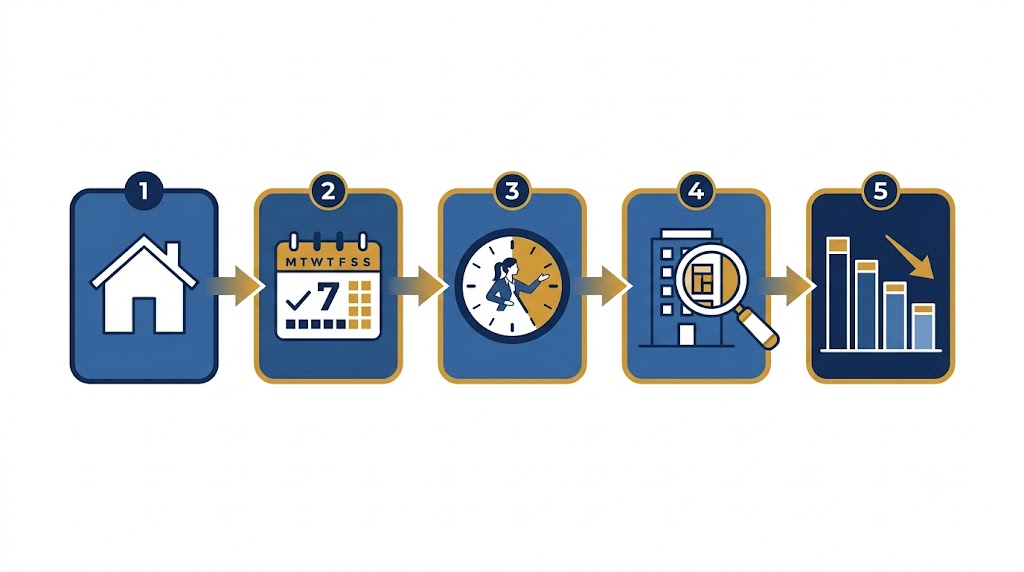
Here’s the strategy in plain English:
- You buy an investment property
- You operate it as a short term rental on Airbnb or VRBO, with an average stay of 7 days or less
- You materially participate in the rental
- You perform a cost segregation study
- You take bonus depreciation
- That depreciation creates a significant paper loss
- That loss offsets your W2 income, reducing or even eliminating your tax bill
That’s the loophole.
How do you qualify for the short term rental tax loophole?
To qualify, you must meet both, not just one.
- Your average stay is seven days or less
- You materially participate in the rental
Material participation, explained
Material participation just means you’re actively involved.
There are seven tests, and you only need to meet one. Here they are, per Treas. Reg. 1.469-5T:
(1) The individual participates in the activity for more than 500 hours during such year;
(2) The individual’s participation in the activity for the taxable year constitutes substantially all of the participation in such activity of all individuals (including individuals who are not owners of interests in the activity) for such year;
(3) The individual participates in the activity for more than 100 hours during the taxable year, and such individual’s participation in the activity for the taxable year is not less than the participation in the activity of any other individual (including individuals who are not owners of interests in the activity) for such year;
(4) The activity is a significant participation activity (within the meaning of paragraph (c) of this section) for the taxable year, and the individual’s aggregate participation in all significant participation activities during such year exceeds 500 hours;
(5) The individual materially participated in the activity (determined without regard to this paragraph (a)(5)) for any five taxable years (whether or not consecutive) during the ten taxable years that immediately precede the taxable year;
(6) The activity is a personal service activity (within the meaning of paragraph (d) of this section), and the individual materially participated in the activity for any three taxable years (whether or not consecutive) preceding the taxable year; or
(7) Based on all of the facts and circumstances (taking into account the rules in paragraph (b) of this section), the individual participates in the activity on a regular, continuous, and substantial basis during such years.
The most common test my clients meet is Test #3: working more than 100 hours on the property, and more than anyone else.
If you manage the property yourself and keep a time log, you’ll likely qualify. But if you hire a property management company, sit back, and collect rent, this strategy won’t work. You’re back to being passive.
Your hours also need to beat any one person, not a business as a whole. So if you use a cleaning company, you need more hours than each individual cleaner who sets foot on the property, not just more than the company’s total. And to stay fully audit-proof, keep a time log for everyone else working on the property, not just yourself. Court cases have shown that this level of documentation matters.
What if you’re married? Married couples can combine hours for material participation, but not for REPS.

What hours count towards material participation?
| Hours That Count | Hours That Don’t Count |
|---|---|
| Hours spent acquiring property (not research hours) | Research hours |
| Showing property to prospective tenants | Education hours (generally) |
| Writing and placing rental ads | Studying and reviewing financial statements or reports (unless you materially participate) |
| Taking tenant applications | Preparing or compiling summaries or analyses of finances or operations for your own use |
| Running background checks and screening tenants | Monitoring the finances or operations in a nonmanagerial capacity |
| Preparing and negotiating leases | Organizing records |
| Cleaning units after tenant move out | Preparing taxes |
| Maintaining the grounds | Paying bills (unless you materially participate) |
| Doing repairs yourself | Watching contractors |
| Doing improvements yourself | Being on call |
| Arranging and managing others doing improvements (not watching) | Hours logged solely to reach the 750 hour requirement |
| Hiring and supervising a property manager | Hours that are not personal service hours |
| Purchasing supplies and materials for rentals | Hours spent in activities where you do not materially participate |
| Inspecting the property | |
| Communicating with tenants and responding to complaints | |
| Collecting rents | |
| Evicting tenants |
Note: Travel time may count if you’re actively managing your rentals during the trip, but the IRS scrutinizes this closely, so keep good documentation. Having a dedicated home office also helps here: it establishes your tax home and place of business, which makes it easier to defend your travel time to and from your rentals in an audit.
Why time logs are nonnegotiable
Time logs that prove material participation are nonnegotiable. I’ll say it again, because people think this is optional. It’s not. Here’s why.
We’ve successfully defended clients before the IRS on the short-term rental loophole, and IRS agents have indeed asked taxpayers to present their time logs. On top of that, the regulations expect this tracking to happen on an ongoing, continuous basis, not reconstructed after the fact once you’re staring down an audit. The goal is to hand your logs over to the auditor within days, not weeks. If it takes you longer than that, it’s a red flag that the log wasn’t being kept in real time in the first place, and courts have consistently thrown out logs that appear to have been reconstructed after the fact rather than tracked in real time.

A real client example with real numbers
Let me walk you through an actual client and what their tax savings looked like. They’re married filing jointly, with a W2 income of about $236,000. You can see more scenarios like this in our case studies.
The left column shows their tax situation without a short term rental. The right column shows the same year as one.
Some background: they bought a short-term rental for $530,000 and put in about $100,000 in improvements, for roughly $630,000 all in. Because they materially participated and had two stays before year-end, each averaging 7 days or less, they qualified for the short-term rental loophole.
They ran a cost segregation study and applied bonus depreciation, resulting in a paper loss of about $163,000.
numbers are rounded
| Without a short term rental | With a short term rental | |
|---|---|---|
| W2 income | $236,000 | $236,000 |
| Paper loss from the STR | $0 | ($163,000) |
| Standard deduction | $29,200 | $29,200 |
| Taxable income | $207,000 | $44,000 |
| Tax owed to the IRS | $35,700 | $4,800 |
| Amount they withheld | $49,000 | $49,000 |
| Refund | $13,300 | $44,200 |
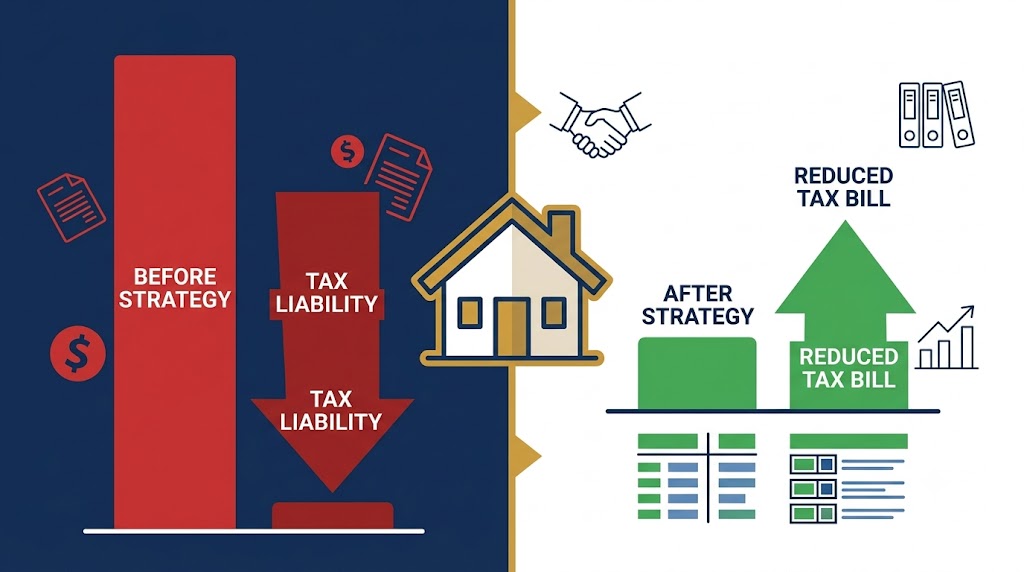
Look at the taxable income line, because that’s the number you actually get taxed on. It dropped from about $207,000 to about $44,000. Their tax bill went from about $35,700 down to about $4,800.
Now, here’s something most people get wrong: a big refund is not a win. That $44,200 refund means they gave the IRS a free, interest-free loan all year. When you plan ahead of year-end, you can adjust your W4 with your employer so you’re not overwithholding in the first place. Yes, your HR department might look at you like you’ve lost your mind, but that’s exactly the point.
If we already know your tax will be $4,800, why hand the IRS $44,200 to hold for free?
That’s the difference between tax prep and tax planning.
The downside nobody warns you about
Everything has a good, a bad, and an ugly, and most people never talk about the ugly. So let me be straight with you.
Year one is the big year. That’s when you take most of the depreciation. There’s still some left after that, but it’ll never be as large as year one. Keep in mind, the most you can ever depreciate is the cost of the property minus the land value. Land itself never depreciates. So if you want the same savings again, you need to be ready to rinse and repeat by buying another property next year.
Depreciation recapture is real. If you sell the property right away, you may owe depreciation recapture. Yes, you can use a 1031 exchange to defer it, but it also carries the basis into your next property, which affects what you’re really able to cost seg again. This is exactly why the planning has to happen before you buy and again before you sell.
Using a generic CPA. The most important part of this entire strategy is the actual implementation. I’ve seen investors invest in the property, invest in the cost segregation, invest in the furniture and improvements, and still use their old CPA and get zero tax savings. Why? Because this strategy touches on many moving pieces most general CPAs don’t work with regularly, such as the de minimis safe harbor election, partial dispositions, and grouping elections, getting it wrong can mean you either lose deductions you were entitled to or create an audit problem down the road. You need a real estate CPA who works in this space day in and day out to prepare your taxes so that this strategy actually works.
Speaking of grouping, one more detail worth knowing: this isn’t a one-time qualification. Your average stay and material participation get rechecked every single year, property by property. Grouping multiple STRs together can make hitting the material participation hours easier, but even with grouping, you still have to separately meet material participation for your STR bucket and your long-term rental bucket if you have both. They don’t combine with each other.
One last thing: don’t invest just for the tax savings
Last piece of advice: don’t do this only for the tax break. The tax savings should be the cherry on top, not the reason. Buy a good property that makes sense as an investment on its own. Then let the tax strategy make a good deal even better.
Frequently asked questions
Is the short-term rental tax loophole legal?
Yes. It’s written into the tax code. It’s not a gray area or a trick. It’s simply the difference between how the code treats passive rental activity versus active participation.
What are the requirements for the short-term rental tax loophole?
There are two, and you need both. Your average guest stay must be seven days or less, and you must materially participate in the rental. Miss either one and the losses stay passive.
Does the short-term rental tax loophole apply to W-2 income?
Yes, and that is the whole point. When the rental is treated as active, its paper losses can offset your W-2 wages. That is why the strategy works for high-income W-2 earners who otherwise have very few options.
Is there an income limit for the short-term rental tax loophole?
There is no upper income cap. It tends to make the biggest difference for earners over $150,000, since that is where the tax savings become most meaningful.
Do I need real estate professional status to use it?
No, and that’s the whole point. Real estate professional status is a different path with a much higher bar. The short-term rental loophole doesn’t require it, as long as your average stay is 7 days or less and you materially participate.
What counts as a short term rental?
A property with an average guest stay of seven days or less. Think Airbnb and VRBO-style stays.
Can I use a property manager?
If you hand everything over to a management company and just collect rent, you’ll likely become passive and lose sight of the strategy. Material participation means you’re actually involved, so keep a time log.
Does this affect my self-employment tax?
If you’re providing bed-and-breakfast-type services, such as daily cleaning, breakfast, or concierge-type extras, the IRS may treat your STR as a business rather than a rental, which means the income could get hit with self-employment tax. This is the flip side of the loophole, so keep the services light if avoiding SE tax matters to you.
How much can it actually save me?
It depends on your income and the property, but as the example above shows, it can be the difference between a $35,700 tax bill and a $4,800 one.
What happens when I sell?
You may owe depreciation recapture. A 1031 exchange can defer the recapture on the real estate itself. Are you thinking through other strategies to offset the gain? Do you have a sounding board, someone who can walk you through the good, the bad, and the ugly, and actually bring strategies to the table? You don’t know what you don’t know. Bottom line: don’t sell without talking to your CPA first.
Ready to see if this works for your situation?
If you’re a high-income earner who’s tired of overpaying, this is exactly what my team does all day. Book a free consult. And if you just want to learn first, come ask me anything inside my free tax community.
Written by Ana Karina Klein, CPA, owner of The Tax Boss and a real estate investor who helps high-income earners use the Internal Revenue Code to legally minimize their tax liability.
Disclaimer: This guide has been prepared for informational purposes only and is not intended to provide, and should not be relied on for, tax, legal, or accounting advice. You should consult your own tax, legal, and accounting advisors before engaging in any transaction or using any information in this guide for tax planning purposes.