
What Is a Cost Segregation Study for Rental Property?
A cost segregation study is a detailed engineering and tax analysis that identifies components of a rental property, such as flooring, cabinetry, plumbing fixtures, landscaping, and site improvements, that the IRS allows to be depreciated over 5, 7, or 15 years instead of the standard 27.5-year residential schedule or 39 years for short-term rentals and commercial property. This reclassification accelerates depreciation deductions and may reduce current-year taxable income.
The study is conducted by a qualified cost segregation professional. The professional reviews construction documents, purchase records, and architectural plans, then performs a physical inspection or desktop analysis to classify each building component into the correct asset category defined by the Internal Revenue Code Section 1245 (personal property) and Section 1250 (real property).
Common assets reclassified in a residential rental property cost segregation study include:
• 5-year property: appliances, carpeting, decorative fixtures, window treatments, certain electrical outlets
• 7-year property: office furniture, security systems, removable cabinetry
• 15 year property: landscaping, driveways, parking areas, sidewalks, fencing, retaining walls
• 27.5 or 39-year property: structural walls, roof, foundation, HVAC ductwork integrated into the building
The IRS does not require a specific format for cost segregation studies, but the Cost Segregation Audit Techniques Guide recommends an engineering-based approach as the most reliable methodology. Studies that lack engineering analysis, rely on rules of thumb, or use unsupported allocation percentages face higher scrutiny during an audit.
How Does a Cost Segregation Study Work for Rental Properties?
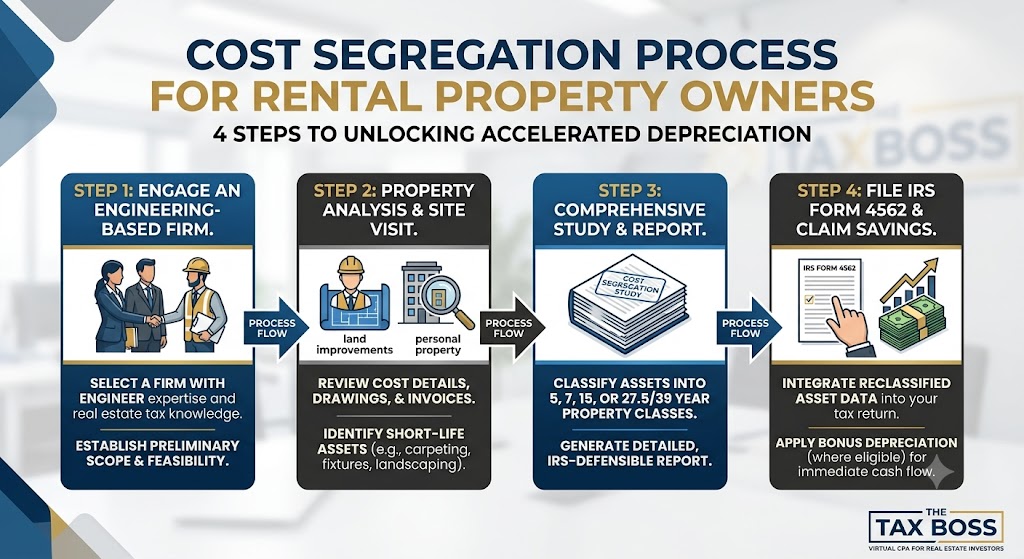
A cost segregation study follows a structured process that combines engineering analysis with tax code compliance. The study produces a detailed report that your CPA uses to file the correct depreciation schedules on IRS Form 4562.
Step 1: Hire a qualified cost segregation firm. The firm should employ licensed engineers and have experience with residential rental properties. Ask whether the firm follows the IRS Audit Techniques Guide methodology and whether the study includes audit defense support.
💡 Pro tip: We have been through IRS audits, and I can tell you that each time cost segregation triggered the audit, we were able to contact the cost segregation company to have them back us up. Peace of mind is priceless.
Step 2: Provide property documentation. The cost segregation firm needs your purchase agreement, closing statement (HUD 1 or settlement statement), construction contracts if the property was built or renovated, architectural plans, and any invoices for capital improvements.
💡 Pro tip: If you are renovating a property, it is very important that you start keeping good records from day 1. The cost segregation company will require those, and it’s better to start now than later.
Step 3: Property inspection and analysis. The engineering team inspects the property (on site or through a desktop review for smaller properties) and identifies every depreciable component. Each component is classified into the appropriate MACRS asset category based on its function, attachment method, and relationship to the building structure.
Step 4: Report delivery and tax filing. The cost segregation firm delivers a detailed report listing every reclassified asset, its cost, and its depreciation schedule. Your CPA uses this report to file IRS Form 4562 (Depreciation and Amortization) with your tax return. If the property was placed in service in a prior year, your CPA files IRS Form 3115 (Application for Change in Accounting Method) to claim the missed depreciation as a catch-up adjustment in the current year.
💡 Pro tip: If this interests you but your CPA advises against a cost segregation study, claiming it lacks value or increases audit risk, it’s worth seeking a second opinion.
How Much Does a Cost Segregation Study Cost?
Cost segregation study fees for residential rental properties typically range from $1,000 to $5,000 per property, depending on the property size, complexity, and methodology used. Keep in mind that the cost for commercial properties can range up to tens of thousands of dollars.
The general industry benchmark is that a cost segregation study is worth pursuing when the property has a cost basis of at least $200,000 to $250,000. At that threshold, the accelerated depreciation deductions typically exceed the study fee by a factor of 5 to 10, creating a clear return on investment.
According to the American Society of Cost Segregation Professionals (ASCSP), a well-executed study on a $500,000 residential rental property commonly identifies $100,000 to $200,000 in assets eligible for accelerated depreciation. At a 37% marginal tax rate, that translates to $37,000 to $74,000 in tax savings over the first 5 to 7 years of ownership.
Keep in mind that these are timing benefits. Cost segregation does not increase total lifetime depreciation. It moves deductions into earlier years, possibly improving your cash flow from a tax perspective. That cash flow advantage is most valuable when you plan to hold the property for at least 5 years or reinvest the tax savings into additional properties.
💡 Pro tip: Before you ever purchase a cost segregation study, we run you through our ROI calculator. Smart tax planning starts with knowing the numbers, so you’ll understand exactly what your return looks like and confirm you qualify before you invest a single dollar.
How Does Bonus Depreciation Affect a Cost Segregation Study in 2026 and after?
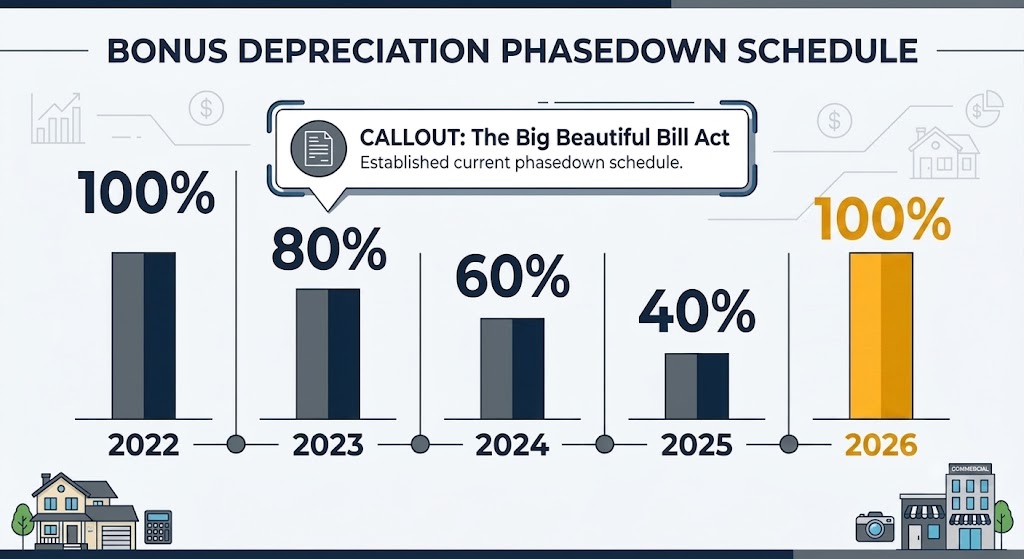
Bonus depreciation determines the percentage of reclassified assets you can deduct in the first year after a cost segregation study. Under the Tax Cuts and Jobs Act of 2017, bonus depreciation was set at 100% for assets placed in service through 2022, then phased down by 20% each year as follows:
• 2024: 60% bonus depreciation
• 2025: 40% bonus depreciation
• 2026: 100% bonus depreciation **
However, thanks to the One Big Beautiful Bill Act passed by Congress in 2025, it includes a provision to restore 100% bonus depreciation retroactively and permanently.
As of today, August 2026, 100% bonus depreciation is in full action and permanent.
*For the 2025 tax year, a critical timing rule caught many real estate investors off guard. To qualify for 100% bonus depreciation, a property must have been both acquired and placed in service after January 19, 2025.
In practical terms: if you signed the contract on a property on November 11, 2024, and it wasn’t placed in service until 2025, you may have assumed you’d earned the full 100% deduction. Unfortunately, the answer is no. Because the acquisition occurred before the January 19, 2025, threshold, that property remains subject to the prior phase-down schedule, limiting you to just 40% bonus depreciation for 2025.
Which Rental Property Owners Benefit Most from a Cost Segregation Study?
Cost segregation delivers the most value for rental property owners who meet one or more of these conditions:
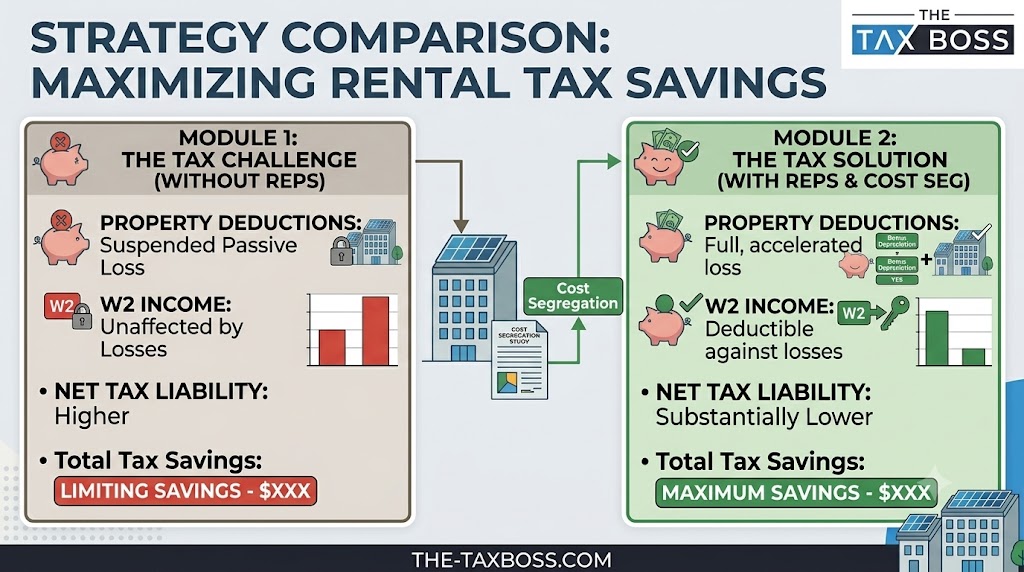
High-income W-2 earners with short-term rentals. If you own a short-term rental property where the average guest stay is 7 days or fewer and you materially participate in the rental activity for at least 100 hours per year, the IRS MAY treats rental losses as nonpassive. This is the short-term rental tax loophole that allows W2 earners to use accelerated depreciation from a cost segregation study to offset their ordinary W2 income, not just passive rental income. Ana Karina Klein, CPA and founder of The Tax Boss, works with high-income professionals who use this strategy to reduce six-figure tax bills.
Real estate professionals (REPS). If you qualify for Real Estate Professional Status ( link the reps guide) under IRC Section 469(c)(7) by spending at least 750 hours per year in real estate activities and more than half your working time in real estate, your rental losses become nonpassive. A cost segregation study paired with REPS status creates substantial first-year deductions that offset all types of income.
Investors who recently purchased or renovated. The optimal time to conduct a cost segregation study is in the year you acquire or complete a renovation on a rental property. If you missed the window, your CPA can file Form 3115 to claim prior year missed depreciation without amending old returns.
Portfolio investors with properties above $200,000 in cost basis. The economics of a cost segregation study improve with property value. A $750,000 duplex or small apartment building can generate $150,000 to $300,000 in reclassified assets, making the $1,500 to $5,000 study fee negligible relative to the tax savings.
Example: Cost Segregation Study on a $878,000 Rental Property
Consider a real estate investor who purchases a single-family rental property for $878,000. The land value is $175,600 (20%), leaving a depreciable cost basis of $702,400.
Without a cost segregation study, the entire $702,400 is depreciated over 27.5 years at approximately $25,540 per year.
With a cost segregation study, the engineering analysis identifies:
• $126,000 in 5 year property appliances, carpeting, decorative lighting, window treatments
• $162,320 in 15 year property
• $415,412 remains as 27.5 year property: structural components, roof, foundation
In year one, assuming 100% bonus depreciation (2026 rate), the investor deducts:
• 100% of 5 year nd 15 year for a total of 286k, expense against their income
• Plus straight line depreciation on the $415,412 of 27.5-year property
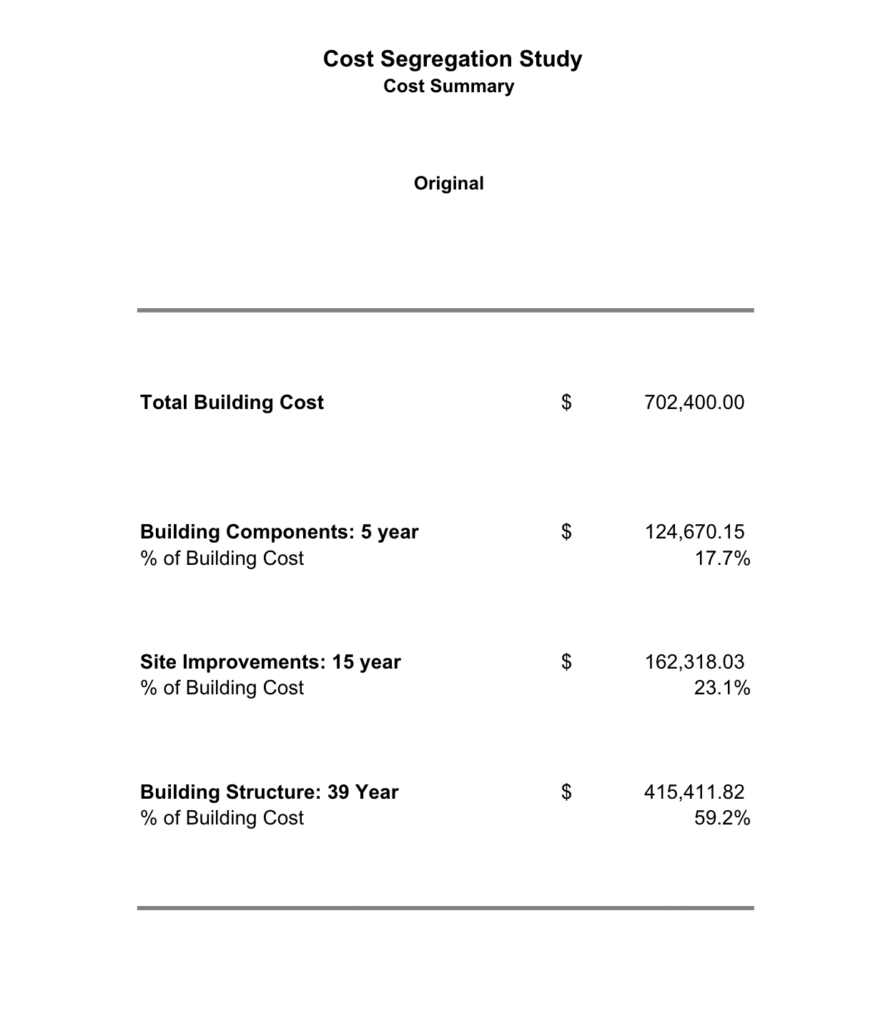
Total first-year depreciation: 286,000, compared to $25k without the study. At a25% marginal tax rate, that creates $55,000 to $60,000 in additional tax savings in year one alone.
Frequently Asked Questions About Cost Segregation for Rental Properties
Can I do a cost segregation study on a property I already own?
Yes. If you placed the property in service in a prior tax year, your CPA can file IRS Form 3115 to change the depreciation method retroactively. The catch-up deduction for all prior years of missed accelerated depreciation is claimed in the current tax year as a Section 481(a) adjustment. You do not need to amend prior-year returns.
Is a cost segregation study worth it for a property under $500,000?
A cost segregation study can be worthwhile for properties with a cost basis as low as $200,000 to $250,000.The key factor is whether the accelerated deductions exceed the study fee by a meaningful margin. For short-term rental owners who can offset W2 income, the threshold is even lower because the tax benefit per dollar of depreciation is higher.
What happens to depreciation when I sell the rental property?
When you sell a property on which you claimed accelerated depreciation through cost segregation, the IRS requires depreciation recapture under Section 1250. The portion of the gain attributable to depreciation on real property is taxed at a maximum rate of 25%. Personal property (Section 1245 assets) that was depreciated and sold at a gain is recaptured as ordinary income. A 1031 exchange can defer both capital gains and depreciation recapture if you reinvest the proceeds into a like-kind property.
💡PRO Tip: This is why you don’t want to buy a house and then sell it in year 2. Tax advantages should be the cherry on top of your investment decisions, not the lead decision maker.
Take the Next Step with The Tax Boss
A cost segregation study is one of the most effective tax strategies available to rental property owners seeking to reduce their current-year tax liability and improve cash flow. Whether you own a single-family rental, a short-term rental, or a small multifamily property, the combination of accelerated depreciation and bonus depreciation can generate tens of thousands of dollars in tax savings.
Ana Karina Klein, CPA, and the team at The Tax Boss specialize in real estate tax planning for high-income earners, short-term rental operators, and real estate investors. Schedule a consultation to determine if a cost segregation study is a suitable option for your portfolio.