
Quick answer
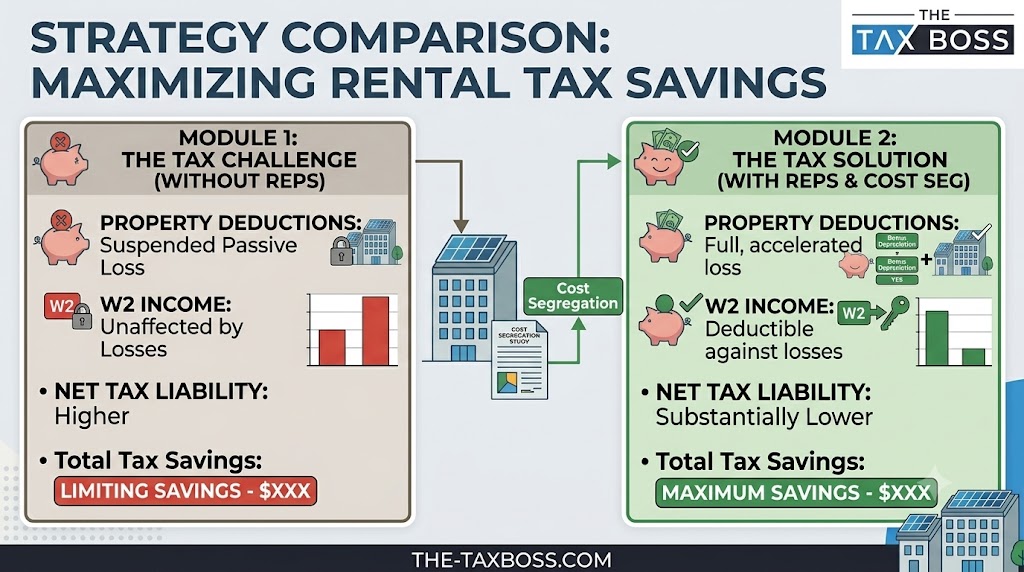
Real estate professional status (REPS) is the tax status that lets you use losses from your rentals to offset your active W-2 or business income, even if your adjusted gross income is over $150,000. It is not getting a real estate license. To qualify, you have to pass two tests: a time test (at least 750 hours and more than half your working time in a real estate trade or business) and materially participate in your rentals.
There are two main reasons people invest in real estate. Number one, to build wealth. Number two, to create paper losses that reduce your taxes. But here is the mistake I see all the time. A high-income earner making over $300,000 goes and buys a turnkey property for $450,000 and thinks it is going to slash their tax bill, and then tax season comes around, and it does absolutely nothing for them.
If you want to understand how real estate actually lowers your taxes before you go buy a property, this guide is for you. Not all real estate is equal for tax purposes, and buying the wrong property for the wrong reasons can cost you hundreds of thousands of dollars.
Here’s what you are going to learn here:
- What qualifies as passive income
- How to qualify for Real Estate Professional Status (REPS)
- Two tests, with in-depth explanations and examples
- Court Cases
- Summary
Everything around this topic comes down to understanding the passive activity rules: Section 469 of the Internal Revenue Code.
By law, real estate income is considered passive (Temp. Reg. Sec. 1.469-1), and any losses arising from passive activity, in this case rentals, are not allowed to offset any active income. Active income is income from your W2, your business, or any other income that is not real estate that you are actively participating in.
This means that if you don’t qualify for Real Estate Professional Status and you have rental losses, they will be suspended (locked away) and will not generate tax benefits. Now, there are ways to open this box and allow the losses. More on that later.
Under IRC Section 469(c)(7)(B), to qualify for REPS, you, as a taxpayer, must meet the following two tests:
Test 1: The “more than half your time” test
More than half (50%) of your total working time must be spent in a real estate trade or business.
Let me give you an example: if you work a full-time job (full-time hours = 2,080) at Chase Bank as a W-2 earner, you must work 2,081 hours in real estate. nearly Impossible. Don’t try it.
Now, I know what some of you are thinking: “Well, I work virtually, and I’m not always on the clock….” If your contract states that you were hired to work full-time, you are disqualified. And if you try, you are technically stealing from two places. Your place of work and the IRS.
But what about those in industries that are 3 days on, 4 off, or similar schedules, or those on call-like firefighter schedules? Same thing. If your contract specifically states you were hired to work full-time, then you can’t claim REPS status, period.
Now there is still a minimum of 750 hours required if you don’t have a full-time W-2 job. In other words, if all your activity is in real estate trade or business, you must still meet a minimum of 750 hours.
This raises the question: Would owning and managing one long-term rental property qualify for REPS? It would depend, but you would have to prove that you meet the 750 hours with just one property.
Let’s now discuss what activities fall under “real estate trade or business.”
IRC Sec 469(c)(7)(C) outlines 11 categories: real property development, redevelopment, construction, reconstruction, acquisition, conversion, rental, operation, management, leasing, or brokerage.
If you are a real estate agent and a flipper, you can group these properties to meet the 750-hour rule per 469(c)(7)(B)
What if you are a transaction coordinator or mortgage lender? Unfortunately, that does not qualify you. Even in my case, as a CPA who specializes in helping clients in real estate, I still don’t meet the first test.
Let’s say that you are a realtor or a developer and you pass test #1. Now you have to pass test #2. Remember it’s both, not one or.
Test #2: Material participation:
You must materially participate in the rental. To determine if you materially participate, the IRS provides specific tests under Sec 1.469-5T(a).
There are seven tests, and you only need to meet one of the following:
(1) The individual participates in the activity for more than 500 hours during such year;
(2) The individual’s participation in the activity for the taxable year constitutes substantially all of the participation in such activity of all individuals (including individuals who are not owners of interests in the activity) for such year;
*(3) The individual participates in the activity for more than 100 hours during the taxable year, and such individual’s participation in the activity for the taxable year is not less than the participation in the activity of any other individual (including individuals who are not owners of interests in the activity) for such year;
(4) The activity is a significant participation activity (within the meaning of paragraph (c) of this section) for the taxable year, and the individual’s aggregate participation in all significant participation activities during such year exceeds 500 hours;
(5) The individual materially participated in the activity (determined without regard to this paragraph (a)(5)) for any five taxable years (whether or not consecutive) during the ten taxable years that immediately precede the taxable year;
(6) The activity is a personal service activity (within the meaning of paragraph (d) of this section), and the individual materially participated in the activity for any three taxable years (whether or not consecutive) preceding the taxable year; or
(7) Based on all of the facts and circumstances (taking into account the rules in paragraph (b) of this section), the individual participates in the activity on a regular, continuous, and substantial basis during such years.
The most common test my clients meet is option #3: working more than 100 hours on the property, and more than anyone else.
If you are married, you can combine your hours for Test #2.
If you are a limited partner in a syndication and you qualify for REPS and have losses from the syndication, there are specific things that need to be looked at to see if they can be used.
What hours count towards material participation?
| Hours That Count | Hours That Don’t Count |
| Hours spent acquiring property (not research hours) | Research hours |
| Showing property to prospective tenants | Education hours (generally) |
| Writing and placing rental ads | Studying and reviewing financial statements or reports (unless you materially participate) |
| Taking tenant applications | Preparing or compiling summaries or analyses of finances or operations for your own use |
| Running background checks and screening tenants | Monitoring the finances or operations in a non-managerial capacity |
| Preparing and negotiating leases | Organizing records |
| Cleaning units after tenant move-out | Preparing taxes |
| Maintaining the grounds | Paying bills (unless you materially participate) |
| Doing repairs yourself | Watching contractors |
| Doing improvements yourself | Being “on-call” |
| Arranging and managing others doing improvements (not watching) | Hours logged solely to reach the 750-hour requirement |
| Hiring and supervising a property manager | Hours that are not personal service hours |
| Purchasing supplies and materials for rentals | Hours spent in activities where you do not materially participate |
| Inspecting the property | |
| Communicating with tenants and responding to complaints | |
| Collecting rents | |
| Evicting tenants |
Note: Travel time may count if you’re actively managing your rentals during the trip, but the IRS looks at this closely, so keep good documentation. Having a dedicated home office also helps here: it establishes your tax home and place of business, which makes travel time to and from your rentals easier to defend in an audit.
Let’s get some examples:
- You are a realtor, and you spend 1,000 hours during the year selling and showing homes, and you don’t have any other businesses. You would qualify for the first test of spending more than half of your time in a real estate trade or business with a minimum of 750 hours.
Now let’s say you have 2 long-term rentals, and you spend very little time managing them. In fact, you hired a property manager, and all you do is sit back and collect rent every month. Here, you would fail Test #2, which means your losses are still passive and not allowed to offset your realtor income. Even though you meet Test #1. - Now let’s say you are a realtor only working 400 hours a year – just helping out your friends and family. However, you manage 5 rentals yourself and spend 400 hours on them during the year. You can qualify here because we can combine the hours for a total of 800, which clears the 750-hour minimum hours in the real estate trade or business. You also meet the material participation rules.
Grouping election:
Let me give you an example so you understand how important it is to hire a CPA who is a real estate expert.
Client: married, one spouse worked a high W-2 job, and the other spouse managed their 10-rental portfolio. They did their own taxes. After three years, they received the dreaded letter from the IRS stating that they owed $96,000 plus interest and penalties. They were sure it was wrong. I mean, TurboTax literally walked them through the entire Schedule E.
Unfortunately, they did not know about the grouping election (Reg. Sec. 1.469-9). Without this formal statement, which needs to be attached to their tax return, the IRS required them to prove that they materially participated in each rental property. It’s not retroactive. The worst part? They owed that 96,000 plus penalties and interest.
This is an extreme example, but using a non-REI CPA or doing your own taxes is the difference between you owing nothing to the IRS and owing over six figures.
What about short-term rentals? Short-term rentals can be qualified as active, and we have seen our clients wipe out tax bills of up to $252,000. Here is a guide on how short-term rentals work.
Now, let’s say you don’t qualify for REPS, but you still have losses from your rentals. Those losses are called suspended losses.
Here are ways you can actually use those losses:
- When you sell your rentals. Any gain on the sale of the rentals can be offset by the suspended losses you have been carrying.
- Generate passive income. If you have a business in which you are passive and it has income, and you can prove it with time logs, you can use rental losses against this.
If you are one of the lucky ones who qualify for REPS, it is extremely important to keep very accurate time logs. Remember that in an audit, you need to prove to the IRS why you took this action. The burden of proof is on you. If you think that going back to redo time logs is a good thing, I can tell you right now, it’s not. The IRS audits that we have successfully defended clients in had airtight time logs.
One thing to note: you must prove REPS status every single year.
Court Cases
As mentioned earlier, qualifying for REPS allows you to take real estate losses against active income. Each of the following cases shows individuals trying to prove they qualify for REPS:
- Penley v. Commissioner (TC Memo 2017-65):
In this case, Penley was a full-time employee who also managed rental properties as a licensed real estate broker. To support his hours, he provided the IRS with a calendar that showed the specific properties he worked on each day, with a brief description, estimated hours worked, and mileage driven to and from the properties. Should be enough to back up REPS, right?
The court did not seem to think so, and this is why:
Penley claimed to work 10-14 hours on the weekends in addition to 4-6 hours during the weekdays solely on real estate activities, bringing his estimated hours worked for the year to 4,714 hours. If this were truly the case, Penley would have had to be working 12-13 hours per day. Ultimately, the court found all entries were rounded up to the nearest half-hour and that no start or end time was specified, so they concluded that this was untrustworthy.
Takeaway: Importance of a detailed and accurate time log
- Gragg v. United States No. 14-16053 (9th Cir. 2016):
Gragg was a real estate agent. She owned rental properties with her husband and assumed that because she was a real estate professional, she met the material participation hours to take their passive losses against their ordinary income. The court disagreed and referenced Treas. Reg. Sec. 1.469-9(e)(3), which states that a taxpayer may not group a rental real estate activity with any other type of real estate activity when determining material participation hours.
This case established that being a REPS and meeting material participation are separate matters. The key takeaway here is that qualifying as a professional only clears the first hurdle. You still have to prove you were materially involved in the specific rental properties generating the loss.
Takeaway: Had she had a CPA who was a real estate expert, her CPA would have told her she needed to meet both tests.
- Hakkak v. Commissioner (T.C. Memo. 2020-46)
Hakkak was a self-employed lawyer who also had real estate investments. A return was filed by Hakkak reporting his main business’s income as passive to offset his passive rental losses for that tax year. The following year, Hakkak filed a similar return where total business income was offset by a loss from a passive real estate activity. This caught the IRS’s attention.
To defend himself, Hakkak provided calendars and support that included only estimates of time for the questioned years. He did not, however, provide the hours he spent attributable to the law firm from which the bulk of his taxable income stemmed.
The court determined that his support was vague and did not prove the 750-hour test or the “more than half” test. If Hakkak kept accurate time logs of all of his activities, there would be a scenario where he meets REPS and material participation that would allow him to treat these rental activities as active.
Takeaway: If you are going to claim that your activities in your business are passive, meaning you don’t do much in them, you’d better have really good records to prove that.
- Miller v. Commissioner (T.C. Memo. 2011-219)
The real estate profession consists of many different roles. From selling agents to builders, many professionals split their time among various real estate-related jobs. Miller worked as a pilot for a tugboat company but was also a general contractor who owned multiple rental properties with his spouse. His wife prepared the written leases for the properties as they found tenants. In addition to this, they were constantly researching and finding new properties. Time sheets were created to keep track of time planning construction, repairs, ordering materials, etc. While the court deemed them imperfect, these helped their case to prove that Miller spent more time on real estate than as a boat pilot.
The combination of time logs and a description of the type of work performed by Miller was used in the final decision of REPS. The court determined that a taxpayer is able to add up all of their hours across all real property trades and businesses to reach the 750-hour and “more than half” tests.
Takeaway: Importance of Time logs.
- Sezonov v. Commissioner (T.C. Memo. 2022-40)
Mr. Sezonov operated an HVAC business as a sole proprietor. In 2013, the business purchased a couple of properties in Florida with the intent to lease while maintaining a primary residence in Ohio.
Repairs and improvements were done to the properties during the year to begin leasing the following year. During 2013, the properties were being advertised via email to potential renters. While Mr. Sezonov assisted in responding to emails, his wife was responsible for day-to-day management.
Losses associated with these rentals were reported on their tax returns, but no election was made to group the rental properties under Section 469(c)(7)(A). To prove REPS, the couple provided the court with a time log with estimated hours (including commute time from OH to FL), with which neither of them met the 750-hour requirement. Regardless of them not meeting the 750 hours, the estimated time log was not accepted as valid support for their hours, as it lacked support and proper detail.
Takeaway: Using a real estate CPA expert would have avoided this
Summary
Being able to claim REPS is one of the most powerful tools in the Internal Revenue Code. However, it is one of the most closely watched by the IRS and therefore not worth gambling with the “they will never know.” It is very hard to achieve, but with the right CPA, you can be successful in an audit.
Take the Next Step Toward REPS Qualification
Real estate professional status can save qualifying investors tens of thousands of dollars annually, but the qualification rules are strict, and the documentation requirements leave no room for error. Working with a CPA who specializes in real estate tax strategy ensures you structure your activities correctly from day one and build an audit-proof time log.
Ana Karina Klein, CPA at The Tax Boss, works exclusively with real estate investors and business owners earning $400,000 or more. Every client receives a dedicated tax advisor who builds a year-round strategy covering REPS qualification, cost segregation, bonus depreciation, and entity structuring.
Book a free discovery call to find out whether REPS is achievable for your situation and how much you could save.
Disclaimer: This guide has been prepared for informational purposes only and is not intended to provide, and should not be relied on for, tax, legal, or accounting advice. You should consult your own tax, legal, and accounting advisors before engaging in any transaction or using any information in this guide for tax planning purposes.